The modern workforce requires more than just the traditional approach to classroom training and bulky training manuals. With new technology and process adoption, employees require the ability to learn, adapt, and retain information at a much higher rate.
Artificial Intelligence and Extended Reality are some of the tools revolutionizing workplace training in this regard.
What are AI and XR?
Artificial Intelligence (AI) personalizes learning by analyzing how workers are performing, identifying where their skills are lacking and providing tailored training plans.
Extended Reality (XR) encompasses:
- Virtual Reality (VR)
- Augmented Reality (AR)
- Mixed Reality (MR)
AI and XR combine to offer interactive learning experiences where employees can practice tasks, receive real-time feedback, and gain confidence in a safe virtual environment.
How AI Improves Learning
AI is transforming workplace education by making it more data-driven and individualized.
Rather than providing each employee with the same training, AI can:
- Suggest individualized learning routes
- Determine the knowledge gaps
- During training, give immediate feedback
- Monitor performance and advancement
- Make recommendations for more educational materials
This helps employees learn at their own pace while enabling organizations to measure training effectiveness more accurately.
How XR Creates Real-World Experience
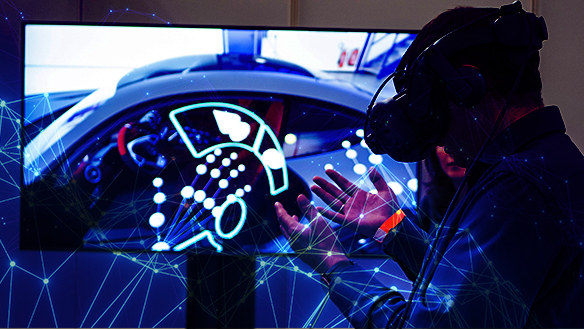
XR enables you to train your teams using an experiential learning approach where they don't just read or watch—they do.
Create immersive simulations for training on everything from equipment operation to safety procedures. Use XR for maintenance workflows, emergency response scenarios, and technical inspections.
Realistic experiences improve your confidence by reducing mistakes and allowing you to retain information for longer periods of time before executing tasks in real environments.
Why XR and AI Work Better Together
The combination of AI and XR is where the true value lies.
Consider a worker receiving training in a virtual factory. AI keeps an eye on their activities as they finish tasks, offers real-time assistance, spots errors, and makes immediate improvement recommendations.
In addition to providing employers with insightful information about employee preparedness and skill development, this produces an extremely engaging learning environment.
The Metahorizon Qvolv Advantage
Today's organizations require a sophisticated, adaptable, immersive training platform.
Metahorizon Qvolv uses AI, AR/VR/MR, Digital Twins, and advanced analytics to assist organizations in modernizing workplace learning.
With Qvolv, organizations can:
- Implement immersive onboarding
- Develop realistic training simulations
- Build digital twins of equipment and/or facilities
- Support remote expert collaboration
- Analyze learners and/or trainees with AI analytics
- Expand training reach and accessibility across multiple teams and locations
Metahorizon Qvolv prioritizes outcome-based learning and cost-effective training for a variety of professions (technicians, health care workers, engineers, and/or manufacturing teams) while simultaneously minimizing operational risks.
Conclusion
The future of workplace training is immersive, intelligent, and experiential. By harnessing the power of AI and immersive technologies, organizations can engage employees and drive better learning outcomes while accelerating acclimation to the workplace and building confidence in their ability to handle real-world scenarios. As businesses continue their digital transformation journeys, embracing AI-powered immersive learning will become table stakes for staying ahead of the curve. With solutions like Metahorizon Qvolv, organizations can future-proof their workforce and prepare them for the challenges of tomorrow.